
Everybody damns the Tunneller; GHQ because he invariably has his job finished months before the rest of the Army are ready for the ‘Great Push’; Army troops because he invariably upsets all their preconceived notions as to the safety of trenches and dugouts; Divisional troops damn him because he is outside their sphere of influence; Brigade troops because he refuses to move when they do and because he knows by heart that part of the line to which they come as strangers; Brass hats because they dislike his underground habits; Regimental officers because he refuses to allow them to use his deep and snug dugouts; Subalterns because of his superior knowledge; Tommy because he is the direct cause of numerous extra fatigues and – alas that it should be so – because of his extra pay; and last and loudest, the Boche damn him because of his earnest and unceasing attempts at uplifting and converting them into surprised angels. It is also owing to his success in this noble work of the missionary that the Tunneller is highly respected by all branches of the forces.
[E Synton, 1918]
Undermining the positions of one’s enemy is one of the most ancient of martial activities. For almost 3000 years before 1914, and even after the invention of gunpowder and the inexorable development of artillery, it was a prime siege-breaking technique; indeed tunnelling is still employed across the world to the present day. The Great War, however, produced the greatest siege the world had ever seen, and its four years of stasis presented a conflict environment that perfectly favoured the skills of the military miner. By the end of May 1915 a continuous trench line, effectively an unbroken pair of fortress walls with no vulnerable flanks, stretched from the North Sea coast to the Swiss frontier. It was to grow into a huge network of defence-in-depth earthworks. With both sides equally well dug-in and deploying comparable troop numbers and armaments, neither was to prove strong enough to force a decisive breakthrough. Siege conditions demanded siege tactics: as the ground was everywhere mineable, the Western Front was a prime candidate for underground warfare.
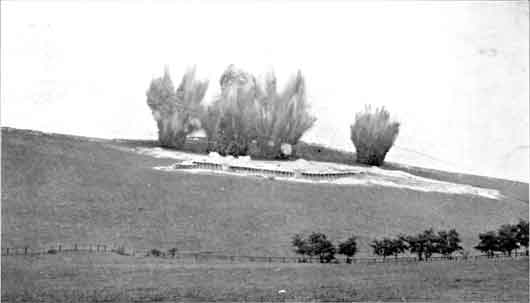
Royal Engineer practice mines being blown as part of a training exercise near Chatham, Kent in 1887. REM.
By a curious twist of fate, military mining against British and Dominion troops began at Givenchy-lès-la Bassée, nearby the site of the new Tunnellers Memorial. On 21 December 1914 the Germans secretly dug shallow tunnels across No Man’s Land and exploded ten small but deadly mines beneath the primitive trenches of the Indian Sirhind Brigade. As the news spread up and down the line, alarm increased: how could this new and unexpected threat be countered? It couldn’t – adequately – for at that time the British had no military mining corps. Further German blows in the new year spurred the British to react with uncharacteristic alacrity.
By March 1915 the first Tunnelling Companies had been formed and were at work in Flanders. By the close of that year mine warfare was more or less continuous wherever opposing trench lines lay within mutual striking distance. It had already become a 24- hour a day, 365-day a year operation. The man shown in the photo to the right is from 172 Tunnelling Company, the first unit William Hackett joined before being relocated to 254 TC in November 1915.

A section of 175 Tunnelling Company. Courtesy of Spellmount Books

A group of potential Tunnelling officers seated outside the RE Library, Chatham. REM
By mid-1916 the British had around 25,000 trained tunnellers. Almost twice that number of ‘attached infantry’ worked permanently alongside them acting as beasts of burden, fetching and carrying the many essential elements of mining paraphernalia, pumping air and water and removing spoil – the earth produced by the digging of the tunnels.
Parts of the Western Front became labyrinths of underground workings. Those troops not directly involved in tunnelling (including attached infantry) were allowed to know little of the aims of a mining scheme simply because the gestation of such endeavours could be so long – well over a year for the Messines offensive of 7 June 1917 – and so arduous, that leakage of information might lead not only to the wastage of colossal effort and the ruination of a plan, but the loss of many lives in the most hideous of circumstances: entombment, drowning, gassing or obliteration in cramped and claustrophobic galleries beneath no man’s land. Close relationships between tunnellers and their attached infantry were formed.
Listening
The tunnelling war was a game of blindfold cat and mouse. The only way to detect one’s enemy underground was by listening. In every tunnelling company considerable numbers of specially-selected men were employed solely on this vital task. Using at first just the naked ear and subsequently sensitive technical devices, listening became a highly developed and efficient art. Installed at the end of their tiny gallery, a trained listener would take notes of the compass bearing and estimated distance of suspect sounds. Comparing the notes of several listeners allowed triangulation of a sound’s origin, and thus an indication as to the location of the enemy, the direction he was heading, and the speed at which he was working. The favoured British listening aid was the Geophone (below). Employing two sensors a listener was able to ascertain the direction of hostile activity by moving the sensors until sound levels appeared equal in both ears. A compass bearing was then taken. When gauging distance only, both earpieces were plugged into a single sensor; this was a skill only gained by experience.
By the end of 1916 the scale of mine warfare had expanded to such an extent that there were not enough listeners to man every post, and central listening stations were devised. Working electronically like a telephone exchange, the signals from up to 36 remote sensors (Tele-geophones and Seismomicrophones) could be distinguished and recorded by just two men.

A sapper using a geophone. Military Mining 1923
Mines and Camouflets
The ultimate effect of an offensive mine, an underground explosion designed to destroy a specific surface target, and usually forming a crater, was dependent upon the quantity, type and quality of explosive used, the nature of the soil and subsoil in which it had been planted, and the depth of the charge. During 1916 one thousand five hundred mines were exploded on the British front, but many thousands of lesser defensive charges were also blown. Known as camouflets (derived from French mining terminology), these were small, controlled and localised underground blasts generally designed not to break the surface and form craters, but to destroy a strictly limited area of underground territory – and its occupants. Two basic techniques were employed. The first was to plant one’s camouflet in one’s own tunnel, a listening post, or in a small spur which was specially dug towards suspect enemy sounds. This was the preferred method in tough ground such as hard clay, or the resilient chalks of Picardy. The second method was more applicable in softer ground, especially in the sandy ridges and spurs of the Ypres (Ieper) Salient. Here, a ‘torpedo’ or ‘Cylinder’ was used. These were specially prefabricated self-contained explosive charges housed in a tube, designed specifically for this kind of warfare. Kept in a store at the rear of tunnel systems, at least one torpedo was always prepared for action, fully charged, primed with a detonator, and ready for instant use. Torpedoes were also used from shallow tunnels to destroy trenches and dugouts.

Cylinder for bore-hole charges
Heavier charges were also used to damage larger areas of underground territory, the purpose being to either destroy substantial sections of hostile tunnels and the occupants, or make the ground so shattered that it was difficult to work. These bigger blows often cratered the surface. The problem with this kind of attack was that one’s own tunnel systems could be equally seriously damaged. Such tactics were used only in extremis, when the hostile threat was acute. This, therefore, was defensive mining, devised and adapted to protect ones own web of tunnels from enemy action. It came to be the main occupation of tunnellers on both sides. Thus a private and secret war was gradually created beneath the battlefields. With improvements in listening and defensive practices, successful offensive attacks against surface targets became less and less frequent. Most mine warfare came to take the form of a clandestine and barbaric battle with tunneller fighting tunneller with camouflets. Hand-to-hand fighting was also not unknown.
Clay-kicking
Clay-kicking (also known as ‘working on the cross’) was a specialist method used in England for driving tunnels for sewer, road and railway works through clay-based geology. In late 1914 the technique was proposed to the army by the creator of the Tunnelling Companies, John Norton-Griffiths, a British engineering entrepreneur who at that time was employing clay-kickers on one of his company’s contracts: the refurbishment of Manchester’s main sewer. Norton-Griffiths persuaded the military that this technique – and his men – were perfect for the clays of Flanders. By February 1915, and as a result of continuing severe enemy mining action, the suggestion was at last taken up. The first batch of kickers – called “Moles’ by Norton-Griffiths – left Manchester on a Thursday; by the following Monday they were already working underground in France – at Givenchy.
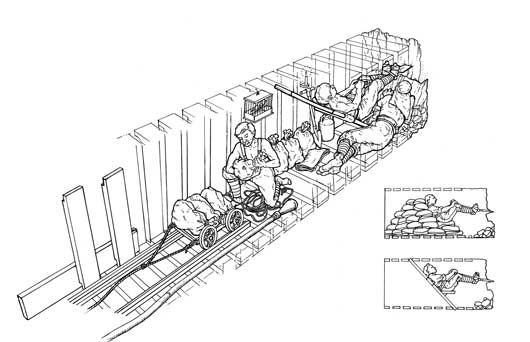
Illustration of clay-kicking method. Drawn by Andy Gammon
In employing the power of the legs to work a specially shaped and finely sharpened spade known as a ‘grafting tool’, clay-kicking allowed a small tunnel to be driven quickly and with minimal effort. The tool was pushed rather than kicked into the working ‘face’ with the feet, each ‘spit’ of clay being then levered out by a prising movement. Progress was thus much faster than digging by hand. Most importantly, however, the technique was almost silent in its application. Digging with a pick or mattock demanded that the earth be struck, creating noise which could be heard by enemy listeners. The Germans never used clay-kicking as it was not a technique employed in civil engineering; indeed, it remained unknown to them for the entire war. German Pioniere thus continued to work with small – and noisy – mattocks. The contrast in digging techniques was a key factor in the ultimate Commonwealth dominance of the subterranean battleground in clay geology. A typical clay-kicking team consisted of a ‘kicker’, who worked at the face, a ‘bagger’, who filled sandbags with the ‘spoil’, the lumps of clay, and a ‘trammer’, who trammed the bags out of the gallery on a small, rubber-tyred trolley on rails; on the return journey this was employed to bring timber in. A clay-kicking team ‘grafted’ for six hours, the shift working on a rotational basis, with the men taking turns at each job. Such teams became close-knit units and stayed together as long as injury, sickness or fate allowed. They were also responsible for timbering the tunnel. Having cut out the rough shape with the grafting tool, a ‘push-pick’ was used to trim the clay to the perfect size to allow a timber ‘sett’ to be installed. A sett consisted of four pieces of wood : a sole for the floor, two side trees (also know as legs), and a cap. The sole went in first, the legs next, and finally the cap. Because of the need for silent working no nails or screws were used; the sole and cap timbers were sawn with small rebated ‘steps’; these located the two legs so that the geophysical pressure of the swelling clays was all that was required to hold the sett firmly in place. Progress was made one sett at a time – nine inches. To encourage drainage the tunnel was always built on a slight uphill gradient of between 1:100 and 1:50. It is likely that the five-man party of which William Hackett was a member were employing clay-kicking to drive their tunnel towards the German lines.
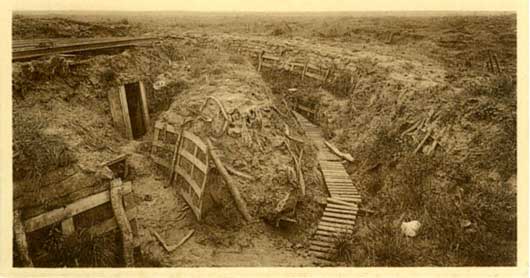
The Zonnebeke sector near Ypres in 1919 showing a trench system with dugout/tunnel entrance. Johan Vandewalle
Shafts
The standard and most simple shafts were built entirely in timber and conformed to centuries-old designs. Although adequate in firm and dry conditions, the varying geological nature of the Flanders battlefields demanded new techniques to cope with the serious problem of bad ground, particularly the layer of quicksand known as the Kemmel Sands, an integral component of the geological make up of all the ridges around Ieper. For the Germans, occupying almost all the most advantageous positions on the ridge tops, this stratum was a serious headache. Tunnelling in the dry strata above the Kemmel Sands was simple, swift and easy, but sinking a shaft through the schwimmsands, as they were known (the British called them running sands), to reach the dry and firm clay geology beneath, was found to be unfeasible: the constantly shifting ground made timber structures almost impossible both to stabilise and waterproof. The sands, which were trapped between the dry stratum above and impervious clay beneath, were also under great geophysical pressure, and often ‘fountained’ when pierced. Believing that the British faced the same insoluble engineering problem, the Pioniere made few efforts to break through the schwimmsands until the spring of 1916.
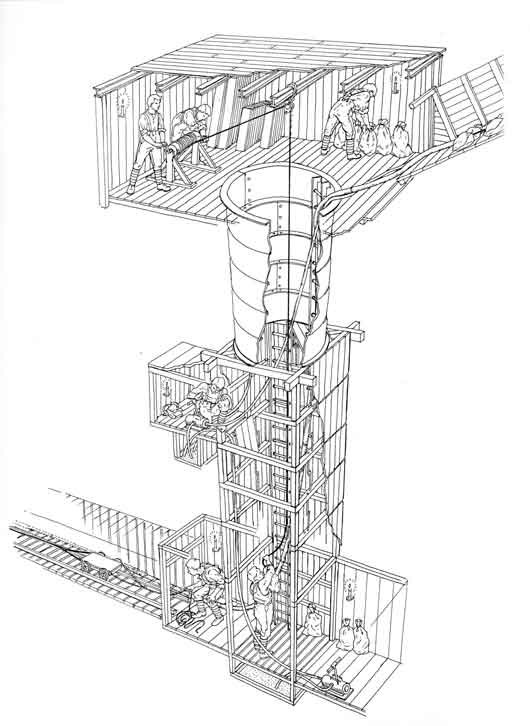
Illustration of steel ‘tubbed’ shaft construction. Drawn by Andy Gammon
What the Germans had failed to realise was that their enemy had conquered the geology by using cylindrical steel shafts known as ‘tubbing’. Tubbing arrived in sections which were bolted together to form a watertight tube. These were sunk through the wet sands (see illustration above) to the dry clay beneath either by the gravitational action of their own weight, or by jacks. Once the steel had reached the dry clay it was again safe to continue the work in timber. The system was quick, simple, strong, stable and waterproof – and allowed the British to delve deep into the Flanders clay in many places where their enemy believed it to be impossible. Critically, the British first used steel shafts as early as May 1915 – almost a full year before the Pioniere. By the spring of 1916 when the Germans were forced to sink watertight shafts in steel (and concrete) because the British had started blowing deep mines, the subterranean war was effectively lost to them. In this ‘year of German ignorance’ the Tunnellers had been able to secretly drive many deep galleries and plant the greatest mines in the history of warfare.
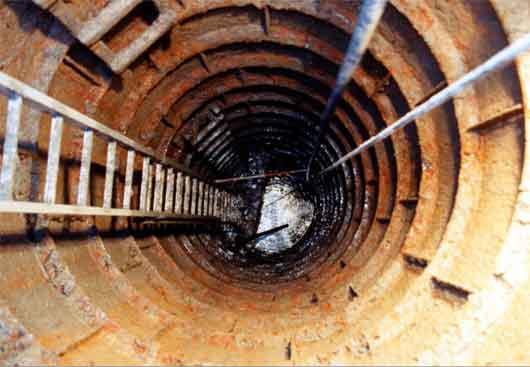
A steel ‘tubbed’ shaft at Lancashire farm near Ypres
Gas
Underground, tunnellers faced many a threat: entombment, obliteration, health problems brought on by the workload, working environment and poor air quality; there was even the risk of drowning. But the biggest killer was actually gas poisoning; not the designed toxic vapour variety used in cloud and shell form by troops on the surface, but carbon monoxide (CO), an invisible, odourless and tasteless substance that was naturally produced by every explosive action – even the firing of a simple rifle bullet. In mines that broke the surface, or in the case of a shell burst, carbon monoxide quickly dissipated into the atmosphere; after an underground explosion, however, it is trapped – in the geology and in the tunnels.
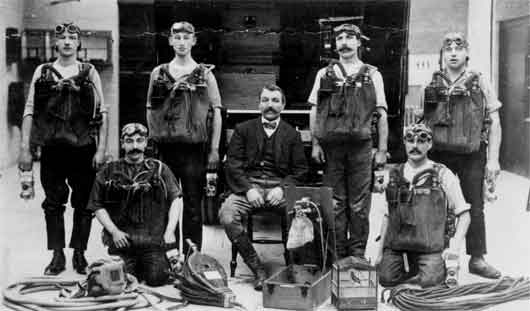
Mine rescue team equipped with torches, bellows, short-range breathing gear, Novita oxygen resuscitation kit, Proto apparatus, ropes and a canary in a cage. REM
Carbon Mnoxide displaces oxygen in the blood. The process is cumulative, resulting in body tissues being gradually starved of oxygen and energy. Death, when it comes, is painless, gentle and insidious, but in the tunnels it was a terrifying prospect. With lowlevel concentrations men could be entirely unaware of its presence, allowing them to penetrate deep into a system before being affected. As little as 0.1 percent CO in air was dangerous, and it was found that a man at rest in an atmosphere of 0.15 percent CO would be affected after two hours, reducing to about forty minutes if working strenuously. A concentration of 0.2 percent caused loss of consciousness in around twenty-five minutes, and 0.3 percent in ten to fifteen minutes. If the gas was present in large quantities, a tunneller could be unconscious in a matter of moments – with little warning. The early symptoms were giddiness, shortness of breath and palpitations, with confusion following. There was then a loss of power in the limbs. When this stage was reached a little exertion would induce loss of consciousness.

Tunneller descending a shaft wearing Proto apparatus. A mouse or a canary would already have been used to detect the presence of carbon monoxide gas. This image shows Sapper 1057 Eugene Kelly (killed 11 April 1918) on duty with 3rd Australian Tunnelling Company in the Hulluch Tunnel near Loos-en-Gohelle. IWM
In extensive mine systems galleries were fitted with regulator doors, effectively producing a series of airlocks. The spread of gas could therefore be isolated so rescue work was simplified and tunnellers in unaffected areas could continue to operate. For rescue purposes several forms of self-contained breathing apparatus were used. However, it was first essential to find out whether the air below ground was ‘gassy’ or not. To achieve this Tunnellers employed the traditional practice of using canaries and mice. As both creatures have a much higher metabolic rate than humans, they are therefore more quickly affected by CO gas. Mice were superceded by canaries as signallers for their curling up in a corner of the cage was not sufficiently evident; a canary, however, was prone to fall off its perch, a more obvious indication of risk. The British eventually organised a highly developed system of rescue. In mining sectors no shaft was further than 200 metres from a station. Proto-men (named after the breathing kit they employed) were highly trained, hand picked men, selected for experience and coolness under pressure. Two men were on duty at all times. Apart from the rescue gear and oxygen reviving equipment each station contained: Ten electric miners lamps, six canaries (or mice) with four mobile cages and two living cages, one saw, one hand axe, three life lines, two mine stretchers, one trench stretcher, one Primus stove, two tins of café au lait, six hot water bottles, six blankets.
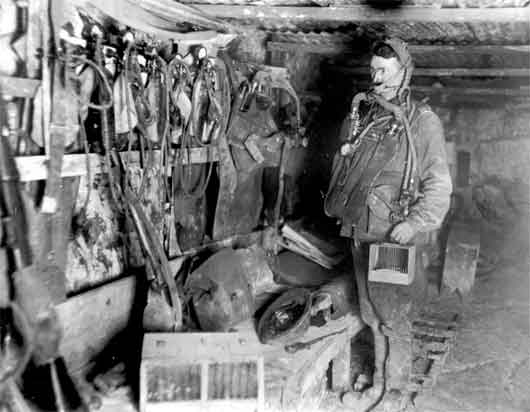
A mine rescue station in Flanders with a sapper ready for descent and other equipment prepared for use. IWM
When in spring 1917 the war became more mobile with the grand sequence of offensives of the Battles of Arras, Messines and Passchendaele, there was no longer a place for a tactic that depended upon total stasis for its employment. Offensive and defensive military mining largely ceased. Underground work continued unabated, however, with the Tunnellers concentrating on mined ‘deep dugouts’ for troop accommodation.
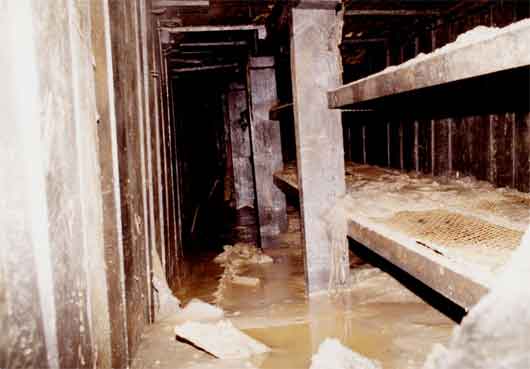
Typical deep dugout accommodation near Ypres: Martha House dugout as seen during an exploration of 1995. Johan Vandewalle
Pingback: THANK YOU FOR YOUR SERVICE | Pointe-Claire Public Library
Pingback: Tunnel Warfare – Munitionettes & Miners